
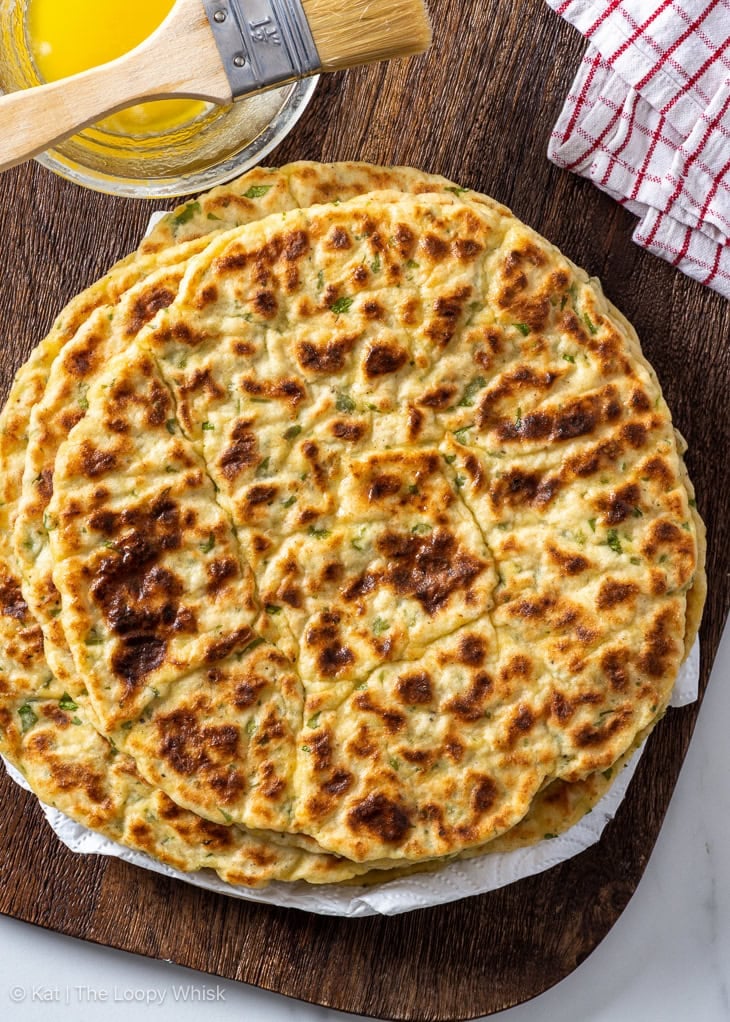
This gluten free potato flatbread is deliciously soft and super easy to make. You can use either riced potatoes or leftover mashed potatoes, the dough comes together in minutes and because it’s a yeast-free recipe, there’s no proofing required. Adding grated cheese, chopped parsley and garlic powder gives the flatbread an amazing flavour, while the potatoes make it extra soft and pillowy.
This is, without a doubt, the softest gluten free flatbread I’ve ever made (yes, even softer than my gluten free naan!), and it’s all thanks to the potatoes. You can use either riced or mashed potatoes in this recipe – in fact, it’s a great way of using leftover mashed potatoes!
The flatbread has a deliciously soft, pliable and pillowy texture, so you can easily roll it up and fold it without any cracking or tearing. Adding grated cheddar cheese, chopped parsley and garlic powder gives it an amazing flavour, but you can also add other herbs and spices, such as thyme, rosemary, red pepper flakes, cayenne pepper and so on.

It’s also super easy to make. The dough comes together in minutes, either by hand or with a stand mixer fitted with the dough hook attachment, and it handles beautifully. You can easily knead it, shape it and roll it out into fairly thin flatbreads without any issues whatsoever – no cracking or tearing. Because it’s a yeast-free flatbread that uses baking powder, you also don’t have to wait for it to proof before you cook it, which makes the recipe even quicker!
And you’d never know it’s gluten free!! I know I say this for pretty much every single one of my recipes but it’s really true. Both the texture and the flavour of this flatbread are absolutely spot on, and even my non-gluten-free taste testers couldn’t tell the difference.
Finally, I should note that while I definitely took inspiration from the Indian aloo paratha and the Norwegian lefse, this recipe is too different to be called either of these. Aloo paratha is typically stuffed with a mashed potato filling (rather than the potatoes being directly incorporated into the dough), while lefse doesn’t contain any cheese or parsley, and typically uses butter, cream and sugar in the dough. That’s why I decided to call this recipe the very generic name of “potato flatbread”, though I’m sure many countries and cultures make something similar.

Before we get to the bits and bobs of making this amazing potato flatbread – if you like what you’re seeing, subscribe to my newsletter to keep up to date on the latest recipes and tips!
Top tips for making gluten free potato flatbread
- You can use either riced potatoes or leftover mashed potatoes. You’ll need 300g of whichever form of potatoes you choose. Make sure that they’re either lukewarm or cooled completely to room temperature before you add them to the dough.
- The best leftover mashed potatoes for this recipe are ones that aren’t overloaded with lots of butter, cream and/or milk. If they’re very rich in fats or contain a lot of milk, you may need to increase the amount of millet flour slightly.
- For best results, weigh your ingredients. The density – that is, the weight per cup – of both riced and mashed potatoes can vary enormously depending on how tightly you pack them (in the case of riced potatoes) and the preparation method (in the case of mashed potatoes). The same goes for gluten free flours: different brands and even different batches can have vastly different densities. So, if you want to get the perfect flatbread every single time, weigh your ingredients with a digital food scale.
- Psyllium husk acts as a binder and a gluten substitute. It ensures that you’ll get a workable dough that you can knead and roll out into individual flatbreads without cracking or tearing, and it gives the cooked flatbread just enough chewiness and flexibility so you can fold it or roll it up.


- You can make the dough by hand or using a stand mixer fitted with the dough hook attachment. In either case, it’s ready in minutes – you just need to knead all the ingredients together until the dough is perfectly smooth with no clumps of either psyllium gel or dry, unmixed flour.
- Roll out each flatbread until it’s about 1-2mm thin and 9-9½ inches (23-24cm) in diameter. Make sure to roll it out on a generously floured surface and lightly flour the top of the flatbread as well, so the rolling pin won’t stick to it. Before you start cooking it, brush away as much of the excess flour as you can.

- Cook the flatbread over medium to medium-high heat, and adjust the heat as necessary during cooking. If the flatbread is browning too quickly, reduce the heat slightly. If it’s taking too long to brown, increase the heat.
- To cook the potato flatbread: cook it on the first side for 1 minute to 1 minute 15 seconds, or until golden brown spots appear underneath. Flip it and brush the top with melted butter. Cook on the second side for about 1 minute or until golden brown spots appear underneath. Flip it again, brush the top with melted butter and cook for about 45 seconds or until the spots underneath are of a deep brown colour. Flip for a final time and cook for about 30 seconds or until the spots underneath are of a deep brown colour.
- Stack the cooked flatbreads on a plate lined with a paper towel – this will absorb any condensation that forms underneath the hot flatbreads. There’s no need to wrap them in a dish towel to trap the steam, they’ll be perfectly soft and pliable without it.
- Serve warm or cooled to room temperature. They’ll stay wonderfully soft and pliable even when cooled completely to room temperature. They’re definitely at their best fresh on the first day, but you can easily reheat them the next day either in a pan on the stovetop or even in the microwave.

Possible substitutions
Although all the ingredients in the recipe should be easily accessible either in your local grocery store or online, I still wanted to include a list of substitutions you can make. (NOTE: all substitutions should be made by weight and not by volume.)
- Psyllium husk: YOU CAN’T SUBSTITUTE IT WITH A DIFFERENT INGREDIENT. But if you use psyllium husk powder as opposed to the whole psyllium husk, use only 85% of the weight listed in the recipe. I recommend using “blond” psyllium husk, as it won’t add any colour or flavour to your flatbread or other bakes.
- Millet flour: You can use an equal weight of finely ground/milled brown rice flour instead.
- Sorghum flour: You can use an equal weight of white teff flour, light buckwheat flour or oat flour instead (the latter only if you’re not sensitive to oats).
A note on measurements (tl;dr: if possible, use a scale)
While I’ve included the volume measurements (cups and spoons) in the recipe card below, if at all possible (and I really cannot overemphasise this): USE METRIC GRAM MEASUREMENTS IF YOU CAN.
They’re much more precise and produce more reliably delicious results. This is true for pretty much all of baking – a kitchen scale will invariably give better results than cups and tablespoons.

And that’s it! This covers everything you need to know about this AMAZING gluten free potato flatbread. I usually use it for wraps, but you can also tear off smaller portions and use it to scoop up dips or sauces.
I really hope you’ll love it as much as I do.
Enjoy!
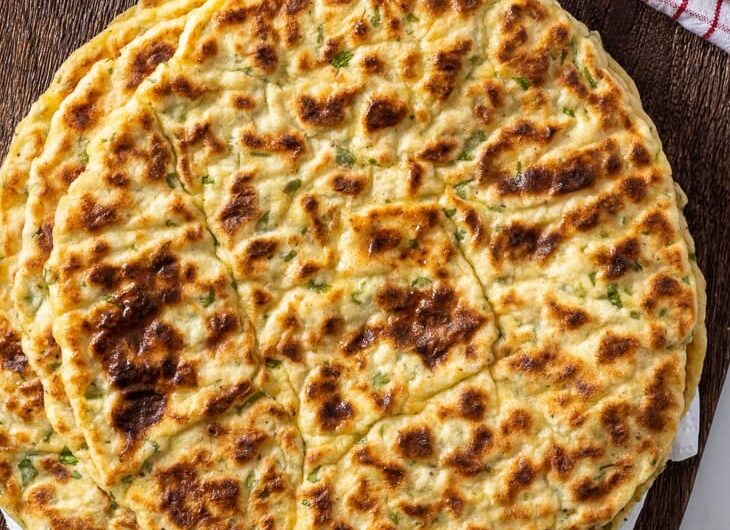
Easy Gluten Free Potato Flatbread
8
servings30
minutes1
hour300
kcalThis gluten free potato flatbread is deliciously soft and super easy to make. You can use either riced potatoes or leftover mashed potatoes, the dough comes together in minutes and because it’s a yeast-free recipe, there’s no proofing required. Adding grated cheese, chopped parsley and garlic powder gives the flatbread an amazing flavour, while the potatoes make it extra soft and pillowy.
Ingredients
2 medium potatoes (You can also use leftover mashed potatoes, ideally ones that aren’t overloaded with lots of butter, cream and/or milk. You’ll need 300g of mashed potatoes, or about 1½ cups – I recommend weighing them for best results.)
25 g (5 tbsp) whole psyllium husk (If using psyllium husk powder, use only 21g.)
330 g (1¼ cups + 2 tbsp) lukewarm water
180 g (1⅓ cups) millet flour, plus extra for flouring the surface (You can use an equal weight of finely ground/milled brown rice flour instead.)
30 g (3½ tbsp) sorghum flour (You can use an equal weight of light buckwheat flour, white teff flour or oat flour instead. Use the latter only if you’re not sensitive to oats.)
½ tsp baking powder
1 tsp salt
½ tsp ground pepper
½ tsp garlic powder
50 g (about ½ cup) coarsely grated/shredded cheddar cheese
6 tbsp chopped fresh parsley
- You will also need:
55 g (½ stick) unsalted butter, melted
Instructions
- For freshly cooked, riced potatoes: Place the washed, skin-on potatoes into a pot and fill it with cold water, enough to fully cover the potatoes. Bring to a boil, then reduce the heat to medium and cook until the potatoes are fork tender (that is, easily pierced with a fork). This usually takes about 30 minutes.
Drain the water and allow the potatoes to cool until warm, then peel them and use a potato ricer to rice them. You’ll need 300g or about 3 cups of riced potatoes. I recommend weighing your riced potatoes, as their density can vary enormously based on how tightly you pack them into the cup. - For leftover mashed potatoes: You’ll need 300g or about 1½ cups of mashed potatoes. I recommend weighing them, as their density can vary greatly depending on the preparation method. Make sure that they’re lukewarm or at room temperature when you add them to the dough.
The best leftover mashed potatoes for this recipe are ones that aren’t overloaded with lots of butter, cream and/or milk. If they’re very rich in fats or contain a lot of milk, you may need to increase the amount of millet flour slightly. - Making the dough:
- You can make the dough by hand or using a stand mixer fitted with the dough hook attachment.
- Make the psyllium gel: In a bowl (or the bowl of a stand mixer, if using), mix together the psyllium husk and lukewarm water. After about 30-45 seconds, a gel will form.
- In a separate bowl, whisk together the millet flour, sorghum flour, baking powder, salt, pepper and garlic powder.
- Add the riced or mashed potatoes (make sure that they’re lukewarm or at room temperature!), grated cheddar, chopped parsley and the dry ingredients to the psyllium gel, and knead everything together until you get a smooth, supple dough. Make sure that there are no clumps of either psyllium gel or dry, unmixed flour.
The final dough should come away from the sides of the bowl and be very springy and supple to the touch. It shouldn’t be too sticky.
Depending on your potatoes, you may need to add up to about 1 tablespoon of extra water to make it softer, or up to about 1 tablespoon of extra millet flour to make it firmer and less sticky. - Dividing & pre-shaping the dough:
- Turn out the dough onto a lightly floured surface and shape it into a ball.
- Divide it into 8 equal portions. You can use a scale to make sure that they’re all of equal weight (each portion should weigh about 115g) or you can just eyeball it.
- Shape the pieces of dough into balls. Don’t worry if the surfaces of the dough balls aren’t perfectly smooth – that’s due to the lack of gluten and it won’t matter in the end, as you’ll be rolling them out anyway. As you move onto the next step (rolling out the flatbreads) keep the dough balls covered with a dish towel to prevent them from drying out.
- Rolling out the flatbread:
- Place a dough ball onto a lightly floured surface and dust its top with more flour.
- Use a rolling pin to roll it out into a large, round flatbread, about 9-9½ inches (23-24cm) in diameter. It should be just under ⅛ inch thin, about 1-2mm.
Make sure to rotate it frequently to prevent it from sticking to the surface. As necessary, dust the work surface and the top of the flatbread with more flour.
Repeat with the rest of the flatbreads.
Tip: I recommend rolling out all the flatbreads first and then cooking them. To prevent them from sticking to each other and drying out, stack them with pieces of parchment/baking paper in between and cover them with a clean dish towel. - Cooking the flatbread:
- Pre-heat a large pan or cast iron skillet over medium to medium-high heat. The pan is ready when a droplet of water sizzles on its surface.
Tip: Throughout the cooking process, adjust the heat as necessary. If the flatbread is browning too quickly, reduce the heat slightly. If it’s taking too long to brown, increase the heat. - Place a flatbread into the hot pan or skillet and cook it on the first side for about 1 minute to 1 minute 15 seconds, or until golden brown spots appear underneath.
Flip it and brush the top with melted butter. Cook on the second side for about 1 minute or until golden brown spots appear underneath.
Flip it again, brush the top with melted butter and cook for about 45 seconds or until the spots underneath are of a deep brown colour.
Flip for a final time and cook for about 30 seconds or until the spots underneath are of a deep brown colour. - Repeat this process with all the other flatbreads. Keep an eye on how they’re cooking and adjust the heat as needed.
- Stack the cooked flatbreads on a plate lined with a paper towel – this will absorb any condensation that forms underneath the hot flatbreads. There’s no need to wrap them in a dish towel to trap the steam, they’ll be perfectly soft and pliable without it.
- Serving & storage:
- These gluten free potato flatbreads are at their very best freshly cooked and still warm, but they’ll still be lovely and soft even a few hours later, after they’ve cooled completely.
- They also keep well in a closed air-tight container in the fridge for 2-3 days. To return them to their original soft, pillowy texture on days 2 and 3, it’s best to reheat them – see below.
- Reheating gluten free potato flatbread (2 options):
- Reheat in the microwave for 30-45 seconds.
- Reheat on the stovetop. Heat a large non-stick frying pan or cast iron skillet over medium heat and lightly spray the flatbread with some water. Then, cook it in the hot pan with the lid on, for about 30-45 seconds on each side.
